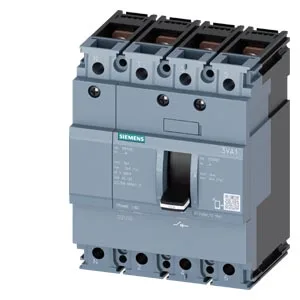
The Siemens 3VA1112-1AA42-0CA0 is a SENTRON switch disconnector in MCCB design — a 4-pole, 125 A rated disconnect that provides visible isolation for a circuit without overload or short-circuit protection. It is built to the IEC 60947-3 standard for switch-disconnectors, meaning its primary job is safe on-load switching and isolation, not protection. The built-in undervoltage release (UVR) is factory-set for 120-127 V AC 50/60 Hz. The UVR does not include a leading contact for delayed dropout; it releases immediately on undervoltage. Connection is via busbar to front terminals, which is the typical arrangement for panel-mounted MCCB-style disconnectors in distribution boards. The front terminals accept busbar connections for the main current circuit. An optional motor drive (field-installable) is available for remote switching.
Dimensions: 70 mm depth, 101.6 mm width, 130 mm height. The width of 101.6 mm (4 inches) is the standard 4-pole MCCB footprint for this frame size.
What it does not include
This is a switch disconnector only — it has no overload protection (no thermal or magnetic trip), no short-circuit protection, and no trip indicator. It is not a circuit breaker. It has no auxiliary contacts (0 CO contacts) and no auxiliary switch. Communication function is not present. The part is designed for applications where isolation and on-load switching are required, and overcurrent protection is provided separately upstream.