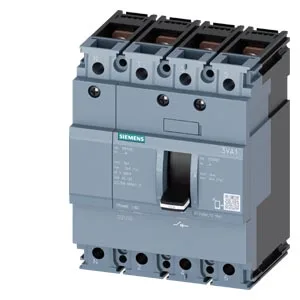
The Siemens SENTRON 3VA1112-1AA42-0CH0 is a 4-pole switch disconnector in the 3VA1 IEC frame 160 platform, rated for 125 A continuous current (Iu) and built without overload or short-circuit protection — it's a disconnect, not a breaker. It lands in a load-isolation or maintenance-disconnect role, typically upstream of a motor starter or downstream of a feeder breaker where the disconnect function is separate from protection.
Rated continuous current Iu is 125 A — that's the current the switch can carry continuously in free air without exceeding the temperature rise limits. The rated insulation voltage Ui is 800 V, and the maximum operational voltage hits 690 V AC 50/60 Hz or 600 V DC. For a 4-pole switch, that 600 V DC rating is useful for battery-bank or DC-bus isolation where you need to break both polarities. The short-time withstand is 2 kA for 1 s and 2 kA for 0.5 s — this is the fault current the switch can hold closed for coordination without welding contacts, not a breaking capacity. It's a disconnect, so the fault clearing happens upstream.
This variant ships with an undervoltage release (UVR) rated 120–127 V AC 50/60 Hz, plus 2 auxiliary switches HQ and 1 trip alarm switch HQ — that's three CO contacts total. The UVR has no leading contact, so it drops out immediately on voltage loss. The switch also accepts an optional motor drive for remote operation, though it's not included here.
The main circuit connects via busbar connection at the front terminals — that's a specific footprint: the busbars land on the front face, not the rear. The 4-pole width at 101.6 mm means it occupies roughly 4 module spaces on a DIN rail if using adapter plates, though the 3VA frame typically mounts on a mounting plate with screws.