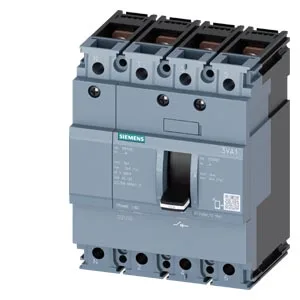
Switch disconnector for isolation duty
Rated for AC operation up to 690 V 50/60 Hz and DC up to 600 V, this unit suits applications where a visible-break isolator is required by code for lockout/tagout, such as motor disconnects, panel main switches, or machine isolation points. The shunt trip (STL) release, accepting 12-30 V DC or 24 V AC, allows remote tripping — useful for emergency-stop circuits or interlocking schemes where the disconnector must open on a signal without an operator at the handle.
Dimensions are 70 mm deep, 101.6 mm wide, and 130 mm tall — the 101.6 mm width (4 inches) occupies four 25 mm DIN-rail module spaces, so plan for a 4-M width in the enclosure layout. Main circuit connections are busbar-style front terminals, meaning the busbars or cable lugs land on the front face rather than the sides — this affects busbar routing and requires clearance in front of the device for tool access.
Maximum power dissipation is 38 W at rated load, which should be factored into enclosure thermal calculations, particularly in densely populated panels. Operating temperature range is -25 °C to +70 °C, with storage from -40 °C to +80 °C — suitable for most indoor industrial environments but verify if the panel ambient exceeds 70 °C near ovens or furnaces.