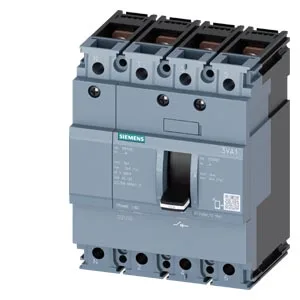
The Siemens SENTRON 3VA1112-1AA42-0KA0 is a 4-pole switch disconnector in an MCCB-style package, rated 125 A continuous across the full 40 °C to 70 °C ambient range — no derating needed as the panel warms up. It carries the IEC frame 160 footprint and comes factory-fitted with a shunt trip (STL) release for remote tripping on 220–250 V DC or 208–277 V AC control circuits.
Rated insulation voltage Ui is 800 V, and the maximum operating voltage reaches 690 V AC or 600 V DC — so it handles 480 V and 600 V class systems comfortably, with headroom for 690 V industrial networks. The 125 A rating holds flat from 40 °C through 70 °C, meaning a panel that runs hot (say, 55 °C inside the enclosure) still carries the full 125 A without a sizing penalty. That flat curve is unusual for a switch disconnector and simplifies panel design. The shunt trip release is a voltage-trigger device — apply control voltage and it opens the switch. It is specified for 220–250 V DC or 208–277 V AC, which covers common North American and European control voltages. There is no undervoltage release or auxiliary switch on this variant; the shunt trip is the only auxiliary release fitted. Mechanical service life is 15 000 operating cycles typical. For a switch disconnector used mainly for isolation (not frequent motor starting), that is a solid figure — it will outlast most panel reconfigurations.
Front terminals accept busbar connection — the main current circuit is wired from the front, which keeps the panel layout clean and allows busbar stacking. The 4-pole width (101.6 mm) is roughly 4 inches, so it occupies a standard 4-module MCCB footprint on the DIN rail or mounting plate. Front IP40 protection means it is splash-safe in a closed panel but not washdown-rated. Power loss is 38 W maximum at rated current. That is moderate for a 125 A 4-pole device — account for it in the enclosure thermal calculation, especially if several units are ganged.