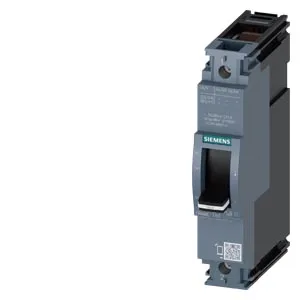
The interrupting rating of 52.5 kA at 240 V AC means it can safely clear a fault current up to that level without welding contacts or rupturing the case; at 415 V AC the interrupting capacity drops to 7.5 kA, so verify the available fault current at your service voltage before committing the BOM line.
Thermal derating and real-world loading
Above 50 °C the continuous current must be reduced: 122 A at 55 °C, 120 A at 60 °C, 117 A at 65 °C, and 114 A at 70 °C (–). If the panel sits near a heat source or in a non-ventilated cabinet, size the load at the derated figure — the TM210 release responds to both thermal (overload) and magnetic (short-circuit) elements, and running at full 125 A in a 70 °C ambient risks nuisance tripping. Maximum power dissipation is 9.37 W, negligible for most DIN-rail layouts but worth tallying in a densely packed enclosure.
The breaker occupies a single 25.4 mm (1 in) width slot on DIN rail, with a depth of 70 mm and height of 130 mm. That 25.4 mm pole pitch is standard for SENTRON 3VA components — it drops into the same rail space as other 1-pole 3VA breakers, so swapping between variants (e.g., different trip ratings or interrupting capacities) does not require re-drilling the backplate or re-routing busbars. Front IP40 protection keeps tools and fingers out but is not rated for washdown; keep it behind a panel door in wet environments.
Operating environment and storage
The storage range exceeds the operating range — that governs handling during shipping and site idle periods, not running conditions. Insulation voltage is rated 500 V, so the 415 V AC / 125 V DC operating voltages sit well within the dielectric margin.