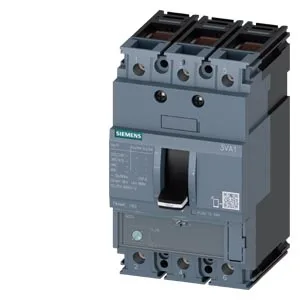
What this MCCB does in the panel
The TM220 thermal-magnetic release means you get a fixed thermal curve for overloads and a fixed magnetic trip for short circuits; no adjustment dials, no interchangeable trip units. That keeps the BOM simple and the coordination study predictable.
This breaker's interrupting capacity is 75.6 kA at 240 V AC, 52.5 kA at 415 V, and 32 kA at 440 V — that's the fault current it can safely clear without welding contacts or rupturing the case. At 500 V and 690 V the rating drops to 11.9 kA, so it's not a high-voltage main breaker; it belongs on a 240–480 V distribution board where the SCCR study gives it room.
What the TM220 release means for coordination
The TM220 designation tells you the thermal element is fixed at the breaker's rated current (125 A here) and the magnetic pickup is fixed at 10 times the rating — so it trips instantaneously at roughly 1250 A. That's a standard motor-circuit or feeder breaker characteristic. No trip indicator on the front, so you won't get a visual flag after a fault; you'll need to check the handle position or wire an auxiliary contact if remote indication matters.
Environmental limits
Maximum power dissipation at full load is 28.1 W — that's per pole, so total heat in the panel is about 84 W. Plan your enclosure ventilation accordingly, especially if the breaker is in a sealed cabinet with other heat sources.