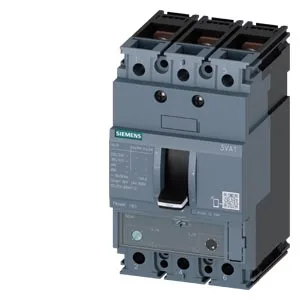
What this MCCB brings to a panel
It carries a continuous rating of 125 A at 40 °C and holds that same 125 A rating through 50 °C, dropping only to 114 A at 70 °C — so it handles warm enclosures without a big derating step. The interrupting ratings climb to 75.6 kA at 240 V and 52.5 kA at 415 V, which gives it headroom for high-fault service entrances or industrial sub-distribution where the available fault current is stiff.
At 240 V this MCCB interrupts 75.6 kA, at 415 V it handles 52.5 kA, at 440 V it still manages 32 kA, and at 500 V and 690 V it's rated 11.9 kA. Those numbers tell a panel designer where this breaker fits in a selective-coordination study: on a 480 V system with a 65 kA available fault current, this breaker sits downstream of a larger upstream device that can take the full fault. The 690 V rating at 11.9 kA also makes it usable on 600 V class Canadian or 690 V European industrial systems, though the interrupting capacity drops at the higher voltage.
Built-in auxiliary switches and undervoltage release
The auxiliary switches and trip alarm give the PLC or building management system a dry-contact status of the breaker position and whether it tripped on fault. A trip indicator on the front confirms a thermal-magnetic trip visually.
That 76.2 mm (3-inch) width for a 3-pole MCCB is standard for the SENTRON 3VA frame size, so it drops into a panel that was laid out for a 3VA family breaker without re-drilling the mounting plate or re-spacing the bus bars. The depth of 70 mm (2.76 in) leaves room behind a 200 mm deep enclosure for wiring and lug access.