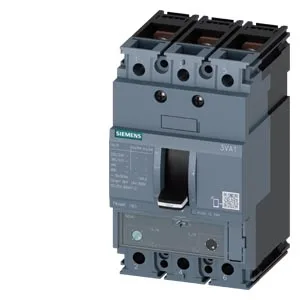
What it is and what it does
The Siemens SENTRON 3VA1112-3EF32-0HH0 is a 3-pole molded case circuit breaker (MCCB) rated for 125 A continuous current, with a TM240 thermal-magnetic overcurrent release. It's built for line protection in distribution panels — think feeder circuits, main switchboards, and sub-distribution boards where you need adjustable thermal and fixed magnetic trip coordination. Breaking capacity is voltage-dependent: 75.6 kA at 240 V, 52.5 kA at 415 V, 32 kA at 440 V, and 10.5 kA at 690 V. That 52.5 kA at 415 V is the number most panel builders will check first for 400 V class systems — it's well above typical utility fault levels for commercial and light industrial services. Rated insulation voltage is 800 V, so it's comfortable on 690 V systems with margin. The front face carries IP40 protection — fine for enclosed panel mounting, not for open washdown areas.
Deployment context and integration
This breaker fits a standard 76.2 mm wide (3-pole) MCCB footprint. Depth is 70 mm, height 130 mm — check your enclosure depth against the 70 mm plus wiring space. The auxiliary contact block is a 2 NO/NC + 1 trip alarm switch (HQ type), factory-integrated. A shunt trip release (STL) is fitted as standard; its part number is 3VA9688-0BL30. Operating temperature range is -25 °C to 70 °C; storage from -40 °C to 80 °C. Current derating starts at 55 °C — 120 A at 55 °C, 117.5 A at 60 °C, 115 A at 65 °C, 112.5 A at 70 °C. If your panel ambient runs hot, factor that in. Mechanical endurance is rated at 15,000 operations — standard for this class of fixed MCCB. No undervoltage release, no communication module, no phase-failure detection on this variant. It's a straightforward thermal-magnetic breaker with a shunt trip for remote opening.
Lifecycle and sourcing reality
For a BOM freeze or a line-down replacement, this is a clean fit: 125 A, 3-pole, TM240 release, shunt trip, auxiliary contacts. If your panel was specified around the sibling 3VA1112-5EF32-0CA0, the mechanical footprint and mounting pattern are the same — the difference is in the release type and accessories, not the frame size. We source and quote to order against an RFQ; availability and current pricing are confirmed at quote time.
