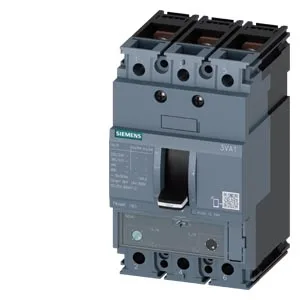
125 A MCCB with TM240 release — line protection for distribution panels
Its 121 kA breaking capacity at 240 V and 75.6 kA at 415 V give it the headroom to clear high-fault currents in distribution panels without cascading failure upstream — a key spec when coordinating selectivity on a 400 V industrial service.
The 125 A rating holds flat from 40 °C through 50 °C, then derates to 120 A at 55 °C, 117.5 A at 60 °C, 115 A at 65 °C, and 112.5 A at 70 °C.
At 70 mm deep, 76.2 mm wide, and 130 mm tall, the 3VA1112-4EF32-0HC0 fits the standard 3VA fixed-pattern cutout. The 76.2 mm width (3-inch grid) matches the 3-pole footprint; if you are swapping from an older 3VF or 3VL series, verify the mounting hole pattern — the 3VA uses the same 4-hole bolt-on pattern as the 3VL, but the lug centers differ. The breaker ships with the shunt trip (STL) and 2 auxiliary switches HQ pre-installed; no field-assembly of those accessories needed.
The interrupting rating steps down with system voltage: 121 kA at 240 V, 75.6 kA at 415 V, 52.5 kA at 440 V, and 11.9 kA at 690 V. For a 400 V panel with a transformer-fed bus that can deliver 65 kA fault current, the 75.6 kA at 415 V gives 10 kA of margin — enough to avoid an upstream breaker upgrade.
The shunt trip (STL) release is wired to a separate control voltage — typically 110–240 VAC or 24 VDC — and fires the breaker open on command from a remote pushbutton, safety relay, or PLC output. The 2 auxiliary switches HQ (high-qualified) provide status feedback: one normally-open and one normally-closed contact per switch, rated for signal-level loads back to the controller.