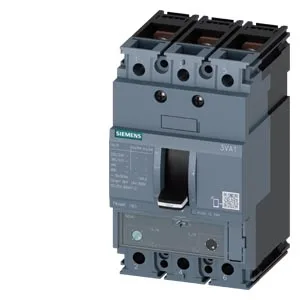
Breaking capacity — the real-world fault-interrupting muscle
The 3VA1112-4EF32-0KC0: This MCCB delivers 121 kA at 240 V, 75.6 kA at 415 V, 52.5 kA at 440 V, and 11.9 kA at 690 V. Those are the maximum prospective fault currents it can safely clear at each voltage level. For a 415 V panel, that 75.6 kA figure gives substantial headroom above typical utility fault levels, so it coordinates well downstream of a larger feeder breaker without needing a current-limiting fuse upstream.
Thermal derating and panel integration
The 125 A rating holds flat from 40 °C through 50 °C ambient, then derates to 120 A at 55 °C, 117.5 A at 60 °C, 115 A at 65 °C, and 112.5 A at 70 °C. If this breaker lands in a crowded enclosure with other heat sources, plan the fill factor so ambient at the breaker inlet stays below 50 °C to avoid losing ampacity. The front face carries IP40 protection — fine for a clean indoor panel, but not for washdown areas. Dimensions are 130 mm height, 76.2 mm width, 70 mm depth; it mounts on a DIN rail or directly to a backplate via the standard SENTRON footprint.
Integrated accessories and release options
The breaker ships with a shunt trip (STL) auxiliary release (design code 3VA9688-0BL33) and 2 auxiliary switches (HQ type). The shunt trip lets a remote signal — from an E-stop, a safety relay, or a PLC output — electrically trip the breaker. No undervoltage release, no ground-fault monitoring, no communication module on this variant. The TM240 thermal-magnetic release handles overload and short-circuit protection; it is not adjustable electronically, so coordination studies rely on the fixed trip curve.
Environmental and endurance specs
Operating temperature range is -25 °C to 70 °C; storage range is -40 °C to 80 °C. Mechanical endurance is rated at 15,000 operations.
