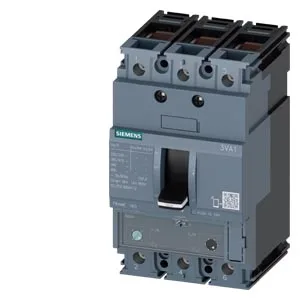
It carries a TM240 thermal-magnetic release, meaning the thermal element is fixed at 125 A and the magnetic short-circuit pickup is set at 240 A — a standard combination for feeder circuits where you want overload protection at the conductor ampacity and a moderate magnetic threshold to ride out motor inrush on mixed loads. The 70 mm depth and 76.2 mm width fit the standard SENTRON 3VA mounting footprint, so it swaps directly into existing 3VA panel layouts without re-drilling the backplate.
Breaking Capacity — What the Voltage Columns Tell You
This breaker's interrupting capacity is specified per voltage level, which is how MCCBs are actually applied. At 240 V it clears 121 kA — that is the symmetrical RMS rating, high enough for most main service entrances on a 240/120 V split-phase or 240 V delta secondary. At 500 V and 690 V it holds at 11.9 kA, which is a standard interrupting level for 690 V industrial feeders.
At 55 °C it drops to 122 A, at 60 °C to 120 A, and at 70 °C to 114 A. That is a shallow derating curve — about 0.2 A per degree above 50 °C — so in a warm panel with ambient near 60 °C you still get 120 A continuous.
The 76.2 mm width (3 inches) is three 25.4 mm pole pitches — standard for a 3-pole MCCB in this frame size. The 70 mm depth (2.76 inches) leaves clearance for rear-connected busbars or cable lugs. The breaker ships without an undervoltage release or shunt trip (no voltage trigger), and without a ground-fault module.