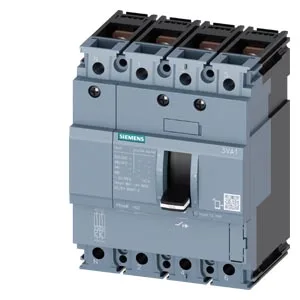
At 415 V it still clears 75.6 kA, and at 690 V it holds 11.9 kA, so the SCCR scales with the system voltage. The magnetic trip can be set up to 1 250 A. At 70 °C the breaker carries 114 A.
The 3VA1112-4FD42-0AA0 measures 130 mm high, 101.6 mm wide, and 70 mm deep — a standard footprint for a 125 A frame that fits a 4-pole group on a DIN rail or bolted to a mounting plate. Maximum power loss is 28.1 W at full load — account for that in your panel thermal budget if you're packing several breakers side by side.
The closest peer in the same frame size is the 3VA1112-5EE32-0AA0. Both are 4-pole 125 A MCCBs, but the 5EE32 uses an electronic release (ETU) instead of the TM210 thermal-magnetic. If your panel was specified around the 5EE32, the 4FD42 will physically drop into the same mounting footprint and bus connection — same 130×101.6×70 mm envelope. The trade-off is the trip curve: thermal-magnetic is simpler and more forgiving in dirty power environments, while the electronic release gives you finer adjustable long-time, short-time, and ground-fault settings. Choose the TM210 if you need a rugged, field-proven breaker with fewer adjustment points to go wrong; pick the ETU if you need selectivity curves and ground-fault coordination.