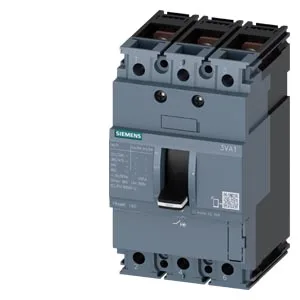
Its rated continuous current Iu is 125 A, and the TM210 overcurrent release gives you a thermal-magnetic trip curve with a fixed magnetic pickup at 10× In (1250 A). That makes it a general-purpose distribution breaker, not a motor-protective device; if you need adjustable magnetic or electronic trip, you'd look at the 3VA1 with an ETU release instead. The breaking capacity figures tell you where this breaker can safely interrupt a fault without welding contacts or rupturing the case: 187 kA at 240 V, 121 kA at 415 V, 75.6 kA at 440 V, and 17 kA at 690 V. For a 125 A frame, those are high-interrupting ratings — the 187 kA at 240 V covers most North American secondary-side fault levels, and the 121 kA at 415 V handles heavy industrial distribution in IEC territories. The temperature derating is published per the datasheet: the breaker carries its full 125 A from 40 °C through 50 °C, then begins to step down — 120 A at 55 °C, 117.5 A at 60 °C, 115 A at 65 °C, and 112.5 A at 70 °C.
Auxiliary and release configuration
The integrated auxiliary trip is order code 3VA9688-0BL30, which is the factory-installed accessory that makes the shunt trip and aux switches work together on the same mechanism.
Mechanical integration and environment
The 76.2 mm width (3 inches) matches the standard 3-pole MCCB footprint for a 125 A frame — it fits the same mounting base and bus-bar spacing as other SENTRON 3VA1 breakers in this current class. Latching endurance is 15,000 operations.