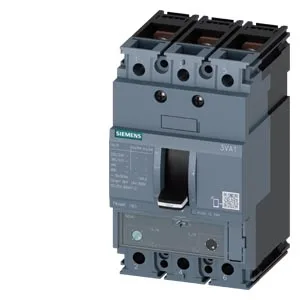
What it is and what it does
The Siemens SENTRON 3VA1112-5EF32-0BA0 is a 3-pole molded case circuit breaker (MCCB) rated for 125 A continuous current, built for line protection in distribution panels. It carries a TM240 thermal-magnetic overcurrent release — the thermal element handles overloads, the magnetic element handles short-circuits, no electronic trip unit to program or power. The rated insulation voltage is 800 V, so it comfortably covers 400 V and 690 V line-to-line systems within its breaking capacity envelope.
Breaking capacity — what the numbers mean for your fault level
This MCCB delivers 187 kA at 240 V, 121 kA at 415 V, 75.6 kA at 440 V, and 17 kA at 690 V. Those are the ultimate short-circuit breaking capacities (Icu) at each voltage — the maximum fault current the breaker can safely interrupt once. For a 415 V panel with a prospective fault level of, say, 85 kA, this breaker clears it with margin. At 690 V the 17 kA figure is the limit; if your upstream transformer can deliver more, step up to a higher-rated frame.
Thermal derating and operating range
The 125 A rating holds flat from 40 °C through 50 °C ambient. Above that it derates: 120 A at 55 °C, 117.5 A at 60 °C, 115 A at 65 °C, 112.5 A at 70 °C. If the breaker lives in a hot enclosure — say a non-ventilated panel next to a furnace line — plan the load at the derated figure, not the nameplate 125 A. Operating ambient range is -25 °C to 70 °C; storage range is -40 °C to 80 °C.
Built-in undervoltage release
This variant includes an undervoltage release (UVR) as the auxiliary release — part number 3VA9608-0BB11 for the integrated trip unit. When line voltage drops below the release threshold, the breaker trips. That is useful for motor circuits that must not auto-restart after a brownout, or for safety disconnects that need to drop out on loss of control voltage. No separate auxiliary contact block is fitted on this version.
Panel fit and protection class
Dimensions are 130 mm high, 76.2 mm wide, 70 mm deep — a standard 3-pole MCCB footprint for DIN-rail or screw-mount panel integration. Front face is IP40, meaning tools and fingers are kept out but the breaker is not sealed against moisture; keep it inside the enclosure, not on a washdown wall. No trip indicator on the front, so fault indication relies on the panel's own annunciation or a downstream auxiliary contact if added.
