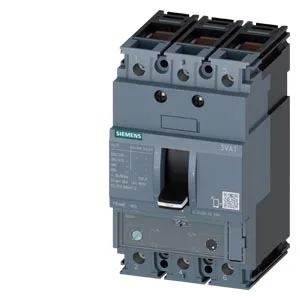
Rated continuous current Iu is 125 A, and the TM240 thermal-magnetic overcurrent release handles the overload and short-circuit protection internally — no separate relay needed. Breaking capacity is the headline number here: 187 kA at 240 V, 121 kA at 415 V, 75.6 kA at 440 V, and 17 kA at 690 V. The 690 V figure (17 kA) tells you it can also serve 690 V industrial networks, though the fault capability drops as voltage rises. Thermal derating is published per ambient temperature: the breaker holds 125 A from 40 °C through 50 °C, then steps down to 120 A at 55 °C, 117.5 A at 60 °C, 115 A at 65 °C, and 112.5 A at 70 °C.
Dimensions: 130 mm height, 76.2 mm width (standard 3-pole MCCB width for the 3VA frame), 70 mm depth. The auxiliary trip is a separate order code 3VA9608-0BB11 if you need to add a shunt trip later. For a main breaker that sees infrequent operation (once a week for maintenance), that's decades; for a breaker used as a daily disconnect, it's still a long service life. The trip indicator is not present on this variant — you'd need a different order code if visual trip flag is required.
For a BOM line that needs this exact order code, the fit is confirmed by the ratings above: 125 A continuous, 3-pole, TM240 release, undervoltage release, 2 aux switches. The breaking capacity at your system voltage (187 kA at 240 V, 121 kA at 415 V, 75.6 kA at 440 V, 17 kA at 690 V) must exceed the available fault current at the installation point — that's the main coordination check.