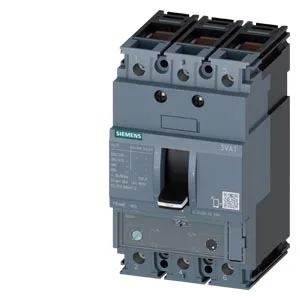
What the ratings mean for fit
The 3VA1112-6EF36-0AC0: Breaking capacity tells you the maximum fault current the breaker can safely interrupt. At 240 V it clears 220 kA; at 415 V, 154 kA; at 440 V, 75.6 kA; at 500 V and 690 V, 17 kA. For a 480 V panel, the 75.6 kA at 440 V is the closest published figure — ample headroom for most industrial service-entrance or feeder applications. The 800 V rated insulation voltage confirms the breaker is built for 690 V systems.
Panel integration and thermal management
The breaker occupies a 3-pole footprint: 76.2 mm wide, 130 mm tall, 70 mm deep. That 70 mm depth is the dimension that matters when the breaker sits behind a gland plate or inside a shallow enclosure — measure the back-of-door clearance before committing. Maximum power loss is 28.1 W, which drives internal cabinet heating; factor it into the thermal rise calculation if the panel is densely packed. Operating temperature range is -25 °C to 70 °C, with storage from -40 °C to 80 °C. The current derating curve starts at 55 °C: 122 A at 55 °C, 120 A at 60 °C, 117 A at 65 °C, 114 A at 70 °C (–). If the panel ambient runs above 50 °C, the breaker still carries 125 A; above that, the derating is linear enough to plan around.
Auxiliary contacts and variants
This order code ships with 2 auxiliary switches (HQ design) fitted — no separate purchase needed for status feedback to a PLC or indication lamp. The basic switch variant is 3VA11126EF360AA0. There is no undervoltage release, no voltage trigger, no ground-fault monitoring, and no communication function on this variant. If those are needed, a different suffix in the 3VA1112 family covers them.
