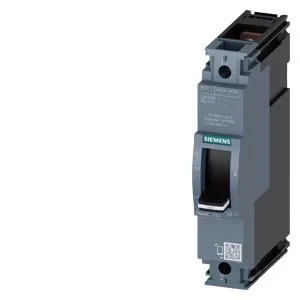
The In=125A continuous current rating is the breaker's nominal — it carries 125 A indefinitely at 40 °C ambient without tripping. The overload protection band is adjustable from Ir=88 A to 125 A, so you set the pickup to match the cable or load, not the other way around. For a 415 V distribution board fed by a transformer of several hundred kVA, 70 kA covers most industrial service-entrance and sub-distribution scenarios. The IEC frame 160 means the breaker body is sized for busbar and lug systems common to 160 A frames — it fits standard 3VA1 mounting plates and withdrawable cassettes.
Built-in signaling for panel integration
The auxiliary switch changes state with the breaker's main contacts — open when the breaker is off, closed when on — so a PLC or status lamp sees the breaker position. The trip alarm switch closes only on a fault trip (overload or short circuit), not on manual switching. That distinction matters for remote diagnostics: you can tell the difference between an operator opening the breaker and a protective trip. Both switches are rated for standard control voltages and terminate at the clamp connection terminals on the breaker face.