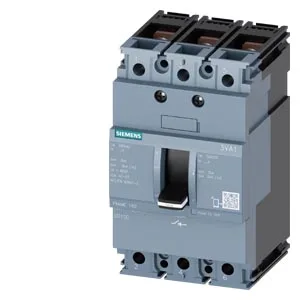
It's a load-break isolating device, not a circuit breaker. The description calls it an SD100 variant: it makes and breaks load current under normal conditions and provides visible isolation, but it won't trip on overcurrent. That's the key distinction for anyone slotting this into a distribution scheme. The 160 A continuous current suits feeder or main-switch duty on sub-distribution boards.
Undervoltage release and auxiliary contacts
There's no leading-contact option on this UVR variant, so the release operates directly on the mechanism without a time delay. Two HQ auxiliary switches (form C, changeover) are fitted as standard. The HQ designation indicates high mechanical reliability — these are rated for the same 15 000 mechanical endurance cycles as the main switch mechanism. The auxiliary contacts share the same front-accessible terminal arrangement as the main circuit, which keeps wiring tidy inside the panel.
Mounting and connections
Main circuit connections are busbar-type, front-terminal arrangement — the switch is designed to bolt directly onto a busbar system or accept busbar plugs.