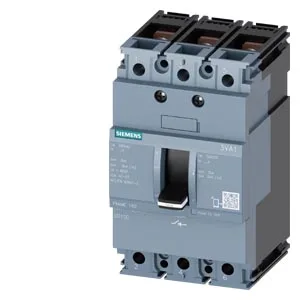
The Siemens SENTRON 3VA1116-1AA32-0HA0 is a 3-pole switch disconnector in an MCCB design, rated for 160 A continuous current (Iu) with a maximum AC operational voltage of 690 V 50/60 Hz and a DC operational voltage of 500 V. The part has no overload or short-circuit protection elements; it is a pure disconnecting switch, not a circuit breaker.
For a 3-pole unit on a 690 V AC line, this covers most motor feeder and distribution applications up to roughly 110 kW at 400 V. The 2 kA limited short-time rating (at both 0.5 s and 1 s) tells you the disconnector can withstand a fault current of 2 kA for up to one second without welding its contacts — this is the withstand rating, not a breaking capacity. It means the device is intended for use downstream of a current-limiting protective device (fuse or MCCB) that clears higher faults before the disconnector sees them. The shunt trip release (STL) operates on a 12-30 V DC or 24 V AC control signal. When voltage is applied to the shunt trip coil, it mechanically trips the disconnector open. This is the standard interface for remote emergency-stop pushbuttons, safety PLC outputs, or fire-alarm interlocks. The release draws its power from the control circuit, not the main bus — verify the control transformer or DC supply can source the inrush current of the shunt trip coil at the moment of trip. The front terminal arrangement with busbar connection means the disconnector is designed for direct busbar mounting in a distribution panel, not for cable lugs. The 76.2 mm width (3-pole) matches the standard 3VA frame size, so it occupies the same DIN-rail or mounting-plate footprint as other 3VA devices.