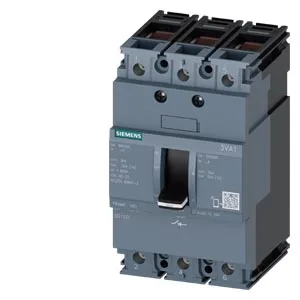
The Siemens SENTRON 3VA1116-1AA36-0AF0 is a 3-pole switch disconnector in the 3VA1 IEC frame 160 family, rated for a continuous current of 160 A. It is designed as a pure disconnecting means — no overload or short-circuit protection built in, so it functions as a load-break switch rather than a circuit breaker. The 160 A rating means it can carry that current continuously in a panel without exceeding thermal limits, and the 3-pole configuration handles three-phase circuits up to 690 V AC or 500 V DC.
The 70 mm depth, 76.2 mm width, and 130 mm height match the standard 3VA1 frame footprint — it occupies the same DIN-rail or mounting-plate space as a 3-pole MCCB in that frame. The 2 kA limited short-time withstand (both 1 s and 0.5 s ratings) tells you this switch disconnector can hold closed under a fault current up to 2 kA for those durations — it's not a high-fault-rated device, so it needs upstream overcurrent protection that clears faults below that level. The 15 000 mechanical endurance cycles (latching) is typical for a switch disconnector in this class; it's rated for frequent switching in normal service.
Deployment context
The optional motor drive (listed as a product extension) allows remote operation, but this base unit ships without one. The absence of undervoltage release and communication function means it's a straightforward manual disconnect — no auxiliary electronics to fail.