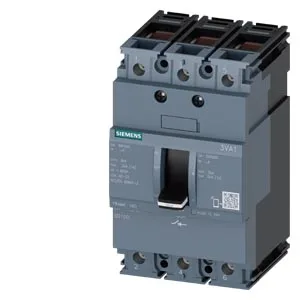
The Siemens 3VA1116-1AA36-0AH0 is a SENTRON switch disconnector in an MCCB-style housing — IEC frame 160, 3-pole, rated for 160 A continuous current. What it is not: a circuit breaker. There is no overload release or short-circuit protection inside this unit. It's a load-break disconnect for isolation and switching, not for fault protection. The product designation on the nameplate reads 'Switch disconnector', and the spec confirms it ships without any auxiliary release or undervoltage trip.
Rated continuous current Iu is 160 A — that's the maximum current the main contacts can carry continuously without exceeding the 38 W power loss limit at full load. The rated insulation voltage Ui is 800 V, and the maximum operational voltage is 690 V AC 50/60 Hz or 500 V DC. That DC rating is worth noting: if you're switching a DC bus at 500 V, this disconnect can handle it, but the 2 kA limited-time rating (1 s or 0.5 s) tells you it's not designed to interrupt high fault currents — it's a disconnect, not a breaker.
Auxiliary contacts and integration
That's enough to signal position back to a PLC or light stack without adding an external contact block. The auxiliary contacts are integrated into the switch, so they share the same mechanical endurance of 15,000 operating cycles. The front terminal connection for the main circuit accepts lug-type conductors; the auxiliary contacts use the standard 3VA accessory wiring scheme.