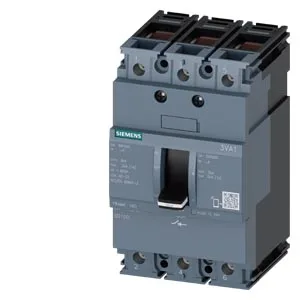
The Siemens 3VA1116-1AA36-0DH0 is a SENTRON 3VA1 switch disconnector in MCCB design, rated for 160 A continuous current (Iu) on a 3-pole frame. It is built to the IEC frame 160 footprint — 70 mm deep, 76.2 mm wide, 130 mm tall — and terminates via front clamp connections. This variant ships without integral overload or short-circuit protection; it is a pure disconnect and isolation device, not a circuit breaker.
The max AC operating voltage of 690 V 50/60 Hz covers 400 V and 480 V systems with headroom; the DC rating of 500 V makes it usable for DC bus isolation in drive line-ups or battery banks up to that voltage. The short-time withstand rating of 2 kA for 1 s (and 0.5 s) tells you this switch can pass through a fault current of that magnitude without welding its contacts — it is not a breaking device for fault currents, but it will hold closed under a 2 kA fault long enough for an upstream breaker to clear.
The front terminal arrangement with clamp connections accepts copper conductors sized for 160 A — typically 50 to 95 mm² cable, though the exact lug range should be confirmed against the terminal specs for the specific clamp supplied. The UVR coil draws its control power from the 208-230 V AC supply; note that this release does not have a leading contact, so the switch must be manually closed against the UVR spring — the UVR does not pre-charge to assist closing. An optional motor drive can be added for remote switching, which is useful for automated load shedding or remote disconnect schemes.