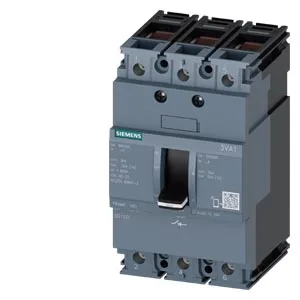
It is a pure disconnect, not a breaker: the trip curve is absent by design (no trip indicator, no undervoltage release). What it carries is a shunt trip (STL) release rated 220-250 V DC or 208-277 V AC, letting you remote-trip the disconnect from a PLC or emergency-stop circuit. The continuous current holds flat at 160 A from 40 °C through 50 °C, then derates to 158 A at 55 °C, 155 A at 60 °C, 153 A at 65 °C, and 150 A at 70 °C — useful when the disconnect lives in a warm cabinet next to drives or transformers. The mechanical service life is 15 000 operating cycles typical, and maximum power loss is 38 W. Front protection is IP40 — fine for a panel interior, not for washdown. Front-terminal connection accepts cable lugs or busbars on the main circuit.
The 3VA1116-1AA36-0KA0 shares the same 76.2 mm width, 130 mm height, and 70 mm depth as the SENTRON 3VA1 IEC frame 160 family, so it drops into the same DIN-rail or panel-mount footprint as the breaker variants. If your panel was laid out for a 3VA1112-5EE32-0AA0 (a 125 A MCCB with TM220 release), the disconnect swaps in without rewiring the bus — same three-pole front terminals, same mounting centers. The difference is functional: the disconnect has no overcurrent protection, so upstream protection must already be in place.