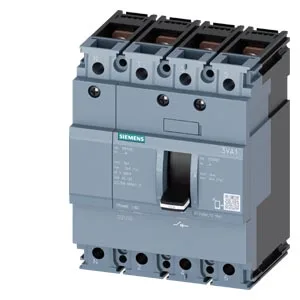
The Siemens 3VA1116-1AA42-0AD0 is a SENTRON 3VA1 switch disconnector in the IEC frame 160, rated for 160 A continuous current across 4 poles. It is built as a pure disconnect device — no overload or short-circuit protection onboard — so it serves as a manual load-break switch or isolator in distribution panels where upstream protection is already in place. Rated for 690 V AC and 600 V DC, it handles line and DC bus applications. The 3 auxiliary switches HQ (3 CO contacts) give status feedback for remote monitoring or interlocking.
The 160 A rated continuous current (Iu) sets the maximum uninterrupted load this switch can carry under normal conditions. For motor loads, thermal protection must come from a separate overload relay or upstream MCCB.
The 70 mm depth and 101.6 mm width fit standard 160 A frame cutouts — it occupies the same footprint as a 4-pole 3VA1 MCCB, so a panel laid out for a breaker can take this disconnect without re-drilling. Main circuit connection is busbar via front terminals — typical for panelboard or switchboard bus risers. The busbar connection keeps the wiring tidy and reduces voltage drop compared to cable tails on high-current runs. The 3 auxiliary switches HQ are factory-integrated, not add-on modules. They save a DIN slot and simplify wiring — the CO contacts can feed a PLC input for position feedback or drive a status lamp on the panel door.
Rated for 15 000 mechanical latching cycles — that is the expected service life before contact wear or mechanism fatigue. For a switch disconnector used as a manual isolator, that translates to years of service before planned replacement.