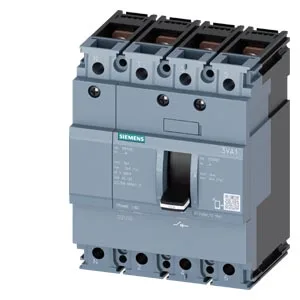
The Siemens 3VA1116-1AA42-0BC0 is a SENTRON switch disconnector built in an MCCB (molded case circuit breaker) form factor. It provides a visible break for safe isolation of a 4-pole circuit rated up to 160 A continuous, without overload or short-circuit protection — that's the job of the upstream breaker. The integrated undervoltage release (UVR) at 24V DC will trip the disconnect if control voltage drops, which is a common safety interlock in machine tools or conveyor lines where loss of control power should open the main disconnect.
At 55 °C it drops to 158 A, at 60 °C to 155 A, at 65 °C to 153 A, and at 70 °C to 150 A. That's a shallow curve, so if your panel ambient stays under 50 °C you get full rated current. Above that, the thermal margin shrinks gradually, not in a cliff. The maximum power loss is 38 W, which is modest for a 160 A frame — helps keep internal panel temperature rise manageable.
Undervoltage release and auxiliary switching
The UVR is a 24V DC coil that holds the disconnect closed when energized. If the DC supply fails or is intentionally removed, the disconnect trips open. The part ships with two HQ auxiliary switches (changeover contacts) for status feedback — one can report the main contact position, the other the UVR state or a separate signal. Both are wired via the front terminal arrangement.
Panel fit and connection
Dimensions are 130 mm high, 101.6 mm wide, 70 mm deep — a 4-pole frame that fits standard MCCB mounting patterns. The main circuit connects via busbar connection on the front terminals, which is the typical arrangement for panelboard or distribution block feed.