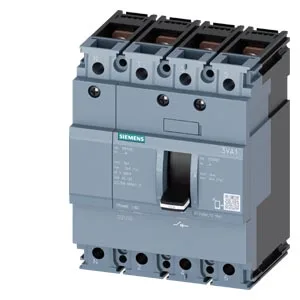
This isn't a circuit breaker — it provides no overload or short-circuit protection. It's a straight disconnect and isolate device, meant for applications where you need to manually break the circuit for maintenance or safety isolation. The auxiliary switches give you status feedback (open/closed) back to the PLC or indication lamp.
The 160 A continuous rating (Iu) is the key selection number — this disconnector is sized for feeder circuits or load groups drawing up to that current continuously. The 800 V rated insulation voltage (Ui) means the internal clearances and creepage distances are designed for 800 V systems, so it's fine for 400 V, 480 V, and 690 V networks. The 2 kA limited short-time rating (1 s and 0.5 s) tells you it can withstand a short-circuit current of 2 kA for those durations without welding or damage, but it's not rated to interrupt a fault — upstream protection (a fuse or MCCB) must clear the fault before the disconnector's thermal limits are exceeded.
Panel integration and connection
The main current circuit connects via busbar connection on the front terminals — no lug terminals here. That means it's designed to bolt directly onto a busbar system (like Siemens 8US or similar), not for individual cable lugs. The front-terminal arrangement gives you good access for busbar links and jumper bars in multi-pole assemblies. The 4-pole design (3 phases + neutral) makes it suitable for three-phase four-wire systems where you need to switch the neutral as well. The width is the key panel-space number — at roughly 4 inches, it's wider than a standard 3-pole MCCB of the same frame, so check your DIN-rail or mounting-plate layout before committing.
For BOM-lock or MRO planners: this is a clean, active line item. The UVR voltage (120-127 V AC) is a common control voltage in North American and some European panels; if your control voltage differs, Siemens offers UVR variants for other ranges within the 3VA accessory family.