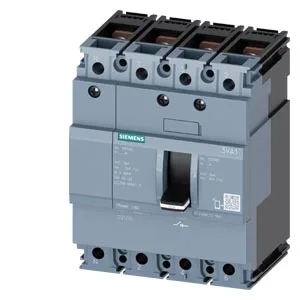
It is a pure isolating and switching device, not a protective breaker.
Rated continuous current Iu is 160 A — that is the current it can carry continuously without exceeding temperature rise limits. For motor loads, this is the full-load current the switch must handle; for distribution, it sets the maximum load on the downstream bus. At 690 V AC it can switch a 160 A load; at 600 V DC the same current rating applies. The integrated shunt trip (STL) release operates on 110–127 V DC or AC 50/60 Hz. This lets you remotely trip the switch from a control signal — emergency stop, safety circuit, or PLC output. No undervoltage release is fitted, so the switch stays latched unless the shunt trip is energized or the handle is manually operated. In a dense panel, that heat must be considered for thermal derating of adjacent devices.
Mounting and connection
The main current circuit connects via busbar connection at the front terminals. That means it is designed to plug onto a busbar system — common in switchboard or panelboard builds — not for cable lugs. The 70 mm depth, 101.6 mm width, and 130 mm height fit the standard 160 A frame footprint across the 3VA family. No auxiliary contacts are fitted, so there is no built-in feedback contact for status indication. If you need a remote open/closed signal, you will need to add an auxiliary switch block from the 3VA accessory range.