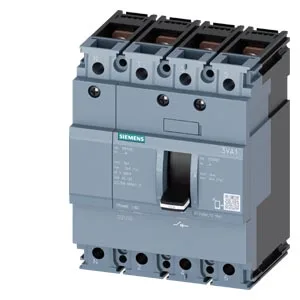
The Siemens SENTRON 3VA1116-1AA42-0KH0 is a 4-pole switch disconnector built in an MCCB-style frame, rated for 160 A continuous current across the ambient range from 40 °C to 50 °C, with a slight thermal derating to 150 A at 70 °C. It carries a full load-break rating at 690 V AC and 600 V DC, making it suitable for isolating both AC motor circuits and DC bus sections in industrial panels. The unit ships with an integrated shunt trip (STL) release for 220–250 V DC or 208–277 V AC, plus a complement of 2 auxiliary switches HQ and 1 trip alarm switch HQ — enough to signal position and fault status back to a PLC or annunciator without adding external contact blocks.
Continuous current and thermal management
The 160 A rating holds flat through 50 °C, then drops to 158 A at 55 °C, 155 A at 60 °C, 153 A at 65 °C, and 150 A at 70 °C. The maximum power loss is 38 W. Above that, the derating curve governs the usable current — a 150 A motor at 70 °C ambient is still within the thermal budget.
The main circuit connects via busbar connections at the front terminals — no rear-panel bus work required. The shunt trip (STL) and auxiliary switches are factory-installed; the STL coil is rated for 220–250 V DC or 208–277 V AC, so it can be driven directly from a control transformer or a DC supply without an interposing relay. An optional motor drive can be added for remote switching.