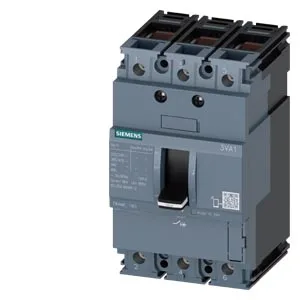
The Siemens 3VA1116-3ED36-0DF0 is a SENTRON molded case circuit breaker rated for 160 A continuous current at 40 °C, holding that full rating through 50 °C before a gentle derating curve begins — 155.2 A at 55 °C, 152 A at 60 °C, 147.2 A at 65 °C, and 140.8 A at 70 °C. Breaking capacity varies sharply with system voltage: 75.6 kA at 240 V, 52.5 kA at 415 V, 32 kA at 440 V, 13.6 kA at 500 V, and 7.5 kA at 690 V. The 415 V figure is the one that matters for most European 400 V distribution — 52.5 kA gives comfortable headroom above typical 25–36 kA fault levels at the main switchboard. The TM210 thermal-magnetic release is a fixed-trip design — no interchangeable rating modules, so the 160 A frame is the breaker's identity.
Panel fit and auxiliary configuration
The breaker measures 76.2 mm wide, 130 mm tall, and 70 mm deep — a standard 3-pole MCCB footprint that fits SENTRON panel-mounting plates and busbar systems without adaptors. The UVR coil drops the breaker on loss of control voltage — standard for emergency-stop or undervoltage protection schemes. The auxiliary trip accessory order code is 3VA9608-0BB25 if a spare is needed.