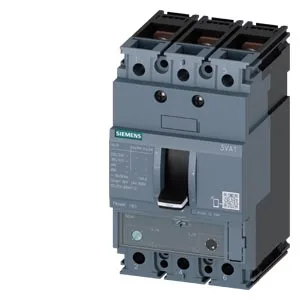
The TM240 thermal-magnetic release gives it a fixed time-current curve, so selectivity studies should start with that curve in hand. Breaking capacity runs 75.6 kA at 240 V, 52.5 kA at 415 V, 32 kA at 440 V, and 10.5 kA at 690 V — enough to handle high-fault panels without cascading upstream breakers, but the 690 V number tells you this isn't a 690 V workhorse; keep it on the 400 V-class bus where it belongs. The operating temperature range runs -25 °C to 70 °C, but the continuous current derating curve starts at 55 °C — 153.6 A at 55 °C, stepping down to 144 A at 70 °C. If the panel ambient sits above 50 °C, factor that derate into the load calculation; the breaker won't trip early, but it'll run warmer than a 40 °C install. Dimensions are 130 mm height, 76.2 mm width, 70 mm depth — a standard 3-pole MCCB footprint for DIN-rail or screw-mount panel integration.
Auxiliary and undervoltage release configuration
The auxiliary switch block is part number 3VA9608-0BB11; if you're swapping a failed UVR or adding a shunt trip later, that's the order code for the auxiliary trip assembly. It's a straight line-protection MCCB with a UVR and aux contacts — nothing more, nothing less. If the BOM calls for remote monitoring or GF protection, this isn't the right pick; step up to the 3VA1 with electronic releases.