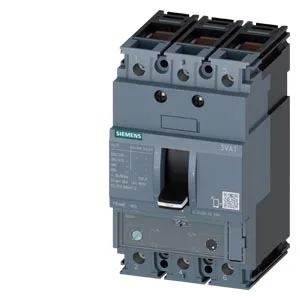
It carries a continuous current of 160 A at 40 °C, with the same rating holding steady through 50 °C — then it derates slightly to 158 A at 55 °C, 155 A at 60 °C, 153 A at 65 °C, and 150 A at 70 °C. The interrupting capacity is what decides whether this breaker survives a fault without welding its contacts shut. At 240 V it clears 75.6 kA; at 415 V it handles 52.5 kA; at 440 V it drops to 32 kA; and at 500 V and 690 V it holds at 11.9 kA. For a 480 V delta or 400 V wye distribution board, that 52.5 kA at 415 V gives you real selectivity margin against a big transformer feeding a fault. That keeps the part simple and reliable for standard feeder protection where you don't need to dial in the trip curve. It's a workhorse breaker, not a smart one.
The 3VA1116-3EF36-0AA0 measures 70 mm deep, 76.2 mm wide, and 130 mm tall — about 2.76 by 3 by 5.12 inches. That width is a standard 3-inch footprint for a 3-pole MCCB, so it drops into most DIN-rail or panel-mount bases without re-drilling. Keep it behind a sealed enclosure door if there's moisture or dust around.
The closest functional sibling is the 3VA1110-5ED32-0AA0 — a 3-pole, 100 A frame with a different release. The 3VA1116-3EF36-0AA0 carries a higher continuous rating (160 A vs 100 A) and a TM240 release versus the 3VA1110's ETU electronic trip. If your load is under 100 A and you want adjustable trip settings, the 3VA1110 is a better fit. But for fixed 160 A feeder protection, this 3VA1116 is the right choice — same footprint, same interrupting ratings, just a simpler release and higher ampacity.