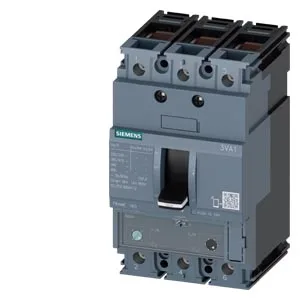
It's built for line protection — main feeder or large subfeed duty in a distribution panel. The interrupting ratings climb: 75.6 kA at 240 V, 52.5 kA at 415 V, 32 kA at 440 V, and 10.5 kA at 690 V. That 75.6 kA number at 240 V means it handles high available fault current on the secondary side of a typical 480 V–240/120 V transformer without needing a current-limiting fuse upstream. You set the breaker once at 160 A and it stays there. That's fine for a dedicated feeder where the load doesn't change seasonally. The shunt trip (STL) on this variant lets a remote signal or emergency-stop circuit drop the breaker without anyone pulling the handle. That gives you two separate status signals — say, one for a remote panel light and one for a PLC input — plus a dedicated alarm contact that only changes state when the breaker trips on fault, not when it's manually opened. The trip indicator on the front confirms the breaker opened on overcurrent, not just a manual switch-off.
Thermal derating — what the table tells you
At 55 °C it derates to 153.6 A, at 60 °C to 150.4 A, at 65 °C to 147.2 A, and at 70 °C to 144 A. The derating curve is linear enough to interpolate between those points.
That 76.2 mm width is a standard 3-pole MCCB footprint — three 25.4 mm pole spacings. No communication module, no ground-fault module, no phase-failure detection — this is a bare-bones thermal-magnetic breaker with a shunt trip and auxiliary contacts.