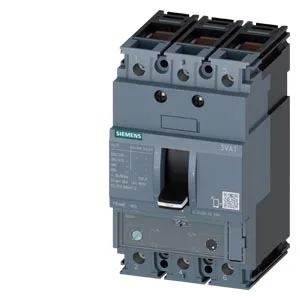
The 3-pole design fits three-phase distribution panels where the neutral is protected separately or left unprotected.
Interrupting capacity — what the voltage ratings mean for your fault level
This MCCB's interrupting capacity varies sharply with system voltage, and the right column for your installation is the one that matches your fault current study. At 240 V it breaks 75.6 kA; at 415 V it's 52.5 kA; at 440 V it drops to 32 kA; and at 690 V it's 10.5 kA. For a 400 V panel with a prospective short-circuit current of, say, 40 kA, the 52.5 kA rating at 415 V gives comfortable headroom. At 690 V the 10.5 kA limit means this breaker is only suitable for systems with low fault levels — check your coordination study before specifying it on a 690 V bus.
Thermal derating — the real-world current you can run
Above that, the derating curve is gradual: 153.6 A at 55 °C, 150.4 A at 60 °C, 147.2 A at 65 °C, and 144 A at 70 °C. If your panel ambient runs 55 °C inside a non-climate-controlled enclosure, you lose about 4% of the continuous rating — plan your load accordingly.
Dimensions are 130 mm height, 76.2 mm width, 70 mm depth — a standard 3-pole MCCB footprint that mounts on a DIN rail or directly to a backplate via the screw terminals. A shunt trip (STL) is built in for remote tripping; the auxiliary release order code for the integrated trip unit is 3VA9688-0BL33. No auxiliary contact block is fitted as standard.