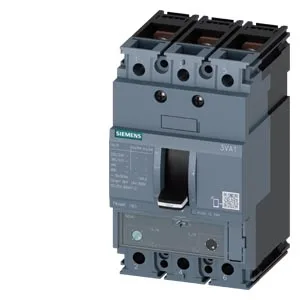
What the ratings mean for your panel
The Siemens SENTRON 3VA1116-4EF32-0JH0 is a 3-pole molded case circuit breaker rated for 160 A continuous current (Iu) at 40 °C, with a TM240 thermal-magnetic overcurrent release. The 121 kA breaking capacity at 240 V AC means it can safely interrupt fault currents up to that level without upstream damage — critical for high-fault installations like transformer secondaries or large motor control centers. At 415 V the rating drops to 75.6 kA, and at 690 V to 11.9 kA, so the voltage at the fault point governs which interrupting rating applies. The 160 A rating holds flat from 40 °C through 50 °C, then derates to 144 A at 70 °C. In a crowded panel with multiple breakers side-by-side, that internal ambient rise is the real limit — not the nameplate. The shunt trip (STL) auxiliary release allows remote tripping via a control signal, and the integrated auxiliary contact pack (2 aux switches + 1 trip alarm switch HQ) provides status feedback to a PLC or annunciator.
Physical fit and panel integration
The breaker measures 130 mm high by 76.2 mm wide by 70 mm deep. That 76.2 mm width (3 inches) is the standard MCCB footprint for a 160 A frame — it occupies three 25.4 mm module spaces on a DIN rail or panel-mount plate. The IP40 front protection means it's sealed against solid objects over 1 mm but not against water; mount it inside a rated enclosure for wet or washdown environments.
Selectivity and coordination note
The TM240 release provides thermal-magnetic protection: the thermal element handles overloads (inverse time), the magnetic element handles short-circuits (instantaneous). For selective coordination downstream, the 121 kA interrupting rating at 240 V gives headroom to coordinate with lower-rated branch breakers. No undervoltage release, no ground-fault monitoring, and no communication function are built in — this is a straightforward line-protection MCCB, not a power-monitoring device.