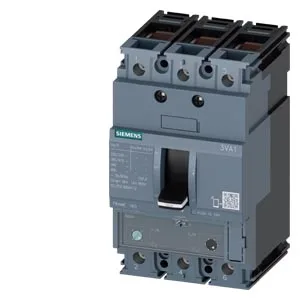
Siemens 3VA1116-4EF36-0KC0 — SENTRON MCCB, 160 A, 3-Pole, High Breaking Capacity
It carries a continuous current rating of 160 A at 40 °C, with minimal thermal derating up to 70 °C (150 A at 70 °C). The 3-pole frame delivers a breaking capacity of 121 kA at 240 V AC, stepping down to 75.6 kA at 415 V and 52.5 kA at 440 V — figures that put it in the high-breaking-capacity class for 160 A MCCBs. The basic switch variant is order code 3VA11164EF360AA0, confirming this is a configured assembly, not a bare frame.
The 121 kA at 240 V is the headline figure, but the more relevant number for a 400 V class panel is the 75.6 kA at 415 V — that is the SCCR the downstream equipment sees in a typical European or Asian 400 V distribution. At 690 V the breaker still holds 11.9 kA, enough for most 690 V motor circuits. The 160 A frame with these interrupting ratings means it can serve as a main or feeder breaker in high-fault panels without cascading upstream.
Dimensions are 130 mm height, 76.2 mm width, 70 mm depth — a compact 3-pole MCCB that fits standard SENTRON panel mounting. The 3VA series uses a common busbar connection pattern, so a panel designed for a 3VA1110 or 3VA1112 frame accepts this 160 A unit without rewiring the bus. The shunt trip (STL) and two auxiliary switches (HQ) are wired to the breaker's internal terminals; verify the STL coil voltage matches the control circuit before commissioning.