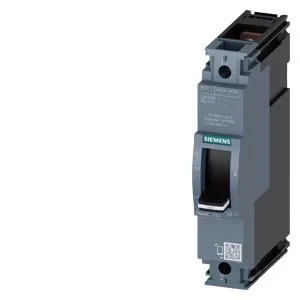
It's built for distribution panels, motor control centers, and feeder circuits where you need adjustable overload and fixed instantaneous protection in a single-pole footprint. The 25.4 mm width (1 inch) per pole means it packs tight on a DIN rail — you can stack multiple poles across a panel without eating up gland-plate real estate. Depth at 70 mm (2.8 in) keeps it clear of shallow enclosure covers. Breaking capacity is 121 kA at 240 V AC and 9 kA at 415 V AC — that 121 kA figure at 240 V tells you it handles high-fault utility feeds or transformer secondaries without cascading upstream. The 9 kA at 415 V is typical for European 400 V distribution; verify your available fault current against that lower number if you're running 400 V line-to-line.
Thermal derating and trip adjustment — what the numbers mean on site
Above that, the TM210 unit derates: 158 A at 55 °C, 155 A at 60 °C, 153 A at 65 °C, and 150 A at 70 °C. Factor that into your load schedule; don't plan on pulling a full 160 A through a hot cabinet. The Ir (thermal pickup) is adjustable from 112 A to 160 A, and Ii (instantaneous magnetic trip) is fixed at 1600 A — that's 10x Ir max. That fixed Ii means it's not for applications needing a lower magnetic threshold (like long motor starts); it's a line-protection breaker, not a motor-circuit protector. The TM210 designation tells you it's thermal-magnetic with a 210 A frame.
The 25.4 mm width per pole means a 1-pole unit occupies a single 1-inch module slot. That covers unheated warehouses and outdoor cabinets in most climates.