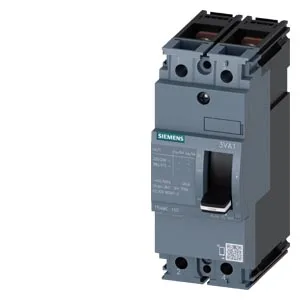
What this MCCB is and what it protects
The Siemens 3VA1116-5ED22-0AA0 is a 2-pole SENTRON molded case circuit breaker (MCCB) designed for line protection — meaning it sits at the incoming feed to protect the distribution bus, not a specific motor or load. It uses a TM210 thermal-magnetic overcurrent release, so the thermal element handles overloads and the magnetic element clears short-circuits. The breaker is rated for a continuous current of 160 A across the 40 °C to 50 °C ambient range, then derates to 150 A at 70 °C. That derating curve matters if you are packing this into a warm enclosure — at 70 °C you lose 10 A of headroom.
Breaking capacity — the real fault-handling number
The interrupting rating is 187 kA at 240 V AC and 121 kA at 415 V AC. At 415 V, that is still a very high fault-current capability — enough for most industrial distribution panels downstream of a large transformer. The rated insulation voltage is 500 V, and the operating voltage is listed at 415 V AC or 250 V DC. If you are using it on a DC bus, check the 3VA device manual for DC-specific derating; the manufacturer flags that separately.
Physical fit and panel integration
The breaker measures 130 mm high, 50.8 mm wide (2 inches — standard MCCB pole spacing), and 70 mm deep. It mounts on a DIN rail or direct panel. The front face carries an IP40 protection rating, so it is protected against tools and wires >1 mm but not against water spray — keep it inside the enclosure, not on the gland plate. There is no undervoltage release, no ground-fault monitoring, and no communication function built in. This is a straight thermal-magnetic breaker with a trip indicator absent; you will see the handle position, not a flag.
