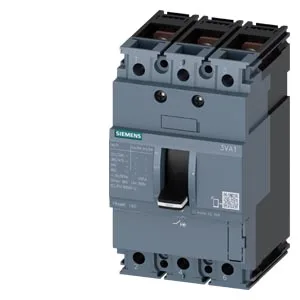
The Siemens 3VA1116-5ED32-0CH0 is a SENTRON 3-pole molded case circuit breaker (MCCB) rated for line protection, carrying 160 A continuously from 40 °C up to 50 °C before it starts to derate — 158 A at 55 °C, 155 A at 60 °C, 153 A at 65 °C, and 150 A at 70 °C. That thermal curve means you size the breaker for the actual panel ambient, not the nameplate; in a well-ventilated 40 °C enclosure it holds full rating.
The interrupting ratings climb steeply with voltage: 187 kA at 240 V, 121 kA at 415 V, 75.6 kA at 440 V, and 17 kA at both 500 V and 690 V.
The UVR means the breaker drops out on loss of control voltage — standard for safety circuits where a downstream contactor or safety relay needs the breaker to open on undervoltage. The HQ trip alarm gives a separate signal contact for remote annunciation, so a PLC or SCADA sees the trip event without wiring through the aux switches.
The 76.2 mm width (3 inches) is the standard 3-pole MCCB footprint — it drops into the same mounting holes as other SENTRON 3VA frame sizes, so swapping from a lower-rated 3VA1110 or 3VA1112 in the same panel requires no drilling or bus-bar rework.