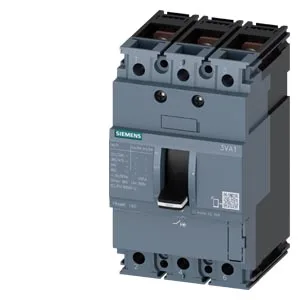
The TM210 designation means the thermal pickup is fixed at 160 A — no field-adjustable dial — and the magnetic short-circuit trip is set at 10× In (1600 A). This is a line-protection version, not a motor-protection or ground-fault variant, so it is sized for feeder or main breaker duty in distribution panels, not for individual motor starting circuits. The interrupting ratings are the headline: 187 kA at 240 V AC, 121 kA at 415 V AC, 75.6 kA at 440 V AC, and 17 kA at 690 V AC. That is a high-interrupting-capacity (HIC) class device, not a standard 25–50 kA MCCB. Thermal derating is flat from 40 °C to 50 °C at 160 A, then drops to 153.6 A at 55 °C, 150.4 A at 60 °C, 147.2 A at 65 °C, and 144 A at 70 °C. If the panel ambient runs at 60 °C, you lose about 6% of the rated current — plan the load accordingly.
Panel fit and auxiliary configuration
The 76.2 mm width is a standard 3-pole MCCB footprint for this current class — it occupies three 25.4 mm pole spaces on a DIN rail or panel-mount base. The shunt trip (STL) release is built in — order code 3VA9688-0BL32 for the integrated auxiliary trip module. No undervoltage release, no communication function, no phase failure detection, no ground fault monitoring. This is a bare-bones line protection breaker with remote trip capability and status feedback, but no metering or network integration. Front protection is IP40 — suitable for dry indoor panel environments. The latching endurance is rated at 15,000 operations, which is typical for a distribution MCCB not cycled daily.