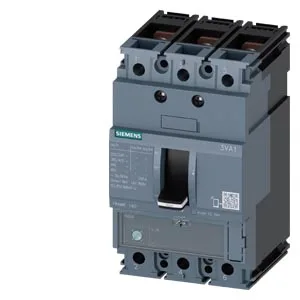
Its breaking capacity hits 187 kA at 240 V AC, dropping to 121 kA at 415 V and 75.6 kA at 440 V — numbers that tell you it handles high-fault utility feeds without cascading upstream. Insulation voltage is rated 800 V, so it's comfortable in 480/277 V or 400/230 V systems with headroom.
The 160 A rating holds flat from 40 °C through 50 °C (–), then derates to 158 A at 55 °C, 155 A at 60 °C, 153 A at 65 °C, and 150 A at 70 °C (–). That means in a warm panel — say 55 °C — you still get 158 A continuous, not a forced downsizing. The 187 kA at 240 V is the short-circuit current rating (SCCR) for a 240 V delta or split-phase service; at 415 V it's still 121 kA, enough for most industrial mains. Power loss maxes at 40.5 W — negligible for panel cooling but a data point for energy-aware designs. The trip indicator gives a visual flag on the breaker face, saving time during fault isolation.
Built-in auxiliary and release options
The UVR drops the breaker when control voltage falls below a threshold — standard for safety disconnects on machine feeds.
That 76.2 mm width is three 25.4 mm pole spaces — standard for a 3-pole MCCB on DIN rail or bolted to a mounting plate. The SENTRON 3VA family shares a consistent footprint across current ratings, so swapping a 100 A for this 160 A unit doesn't force a panel re-drill.