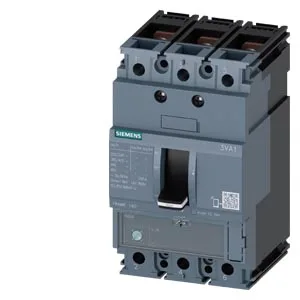
What the 160 A rating means for your panel
The Siemens 3VA1116-5EE32-0CC0 is a SENTRON molded case circuit breaker (MCCB) rated for 160 A continuous current at 40 °C, holding that full rating through 50 °C before it begins to derate — at 55 °C it carries 153.6 A, at 60 °C 150.4 A, at 65 °C 147.2 A, and at 70 °C 144 A. The TM220 overcurrent release handles the thermal-magnetic trip curve, so the breaker responds to sustained overloads and short-circuit events without an external relay. The interrupting ratings are substantial: 187 kA at 240 V, 121 kA at 415 V, 75.6 kA at 440 V, and 17 kA at 690 V.
Panel integration and auxiliary wiring
The breaker measures 76.2 mm wide, 130 mm high, and 70 mm deep — a standard 3-pole MCCB footprint that fits most DIN-rail or screw-mounted panel layouts. The integrated auxiliary trip is order code 3VA9608-0BB24 — that is the specific release module inside, so if you need a replacement or spare, that is the sub-component to order. No communication function, no phase failure detection, no ground fault monitoring — this is a pure line-protection MCCB, not a multifunction power monitor.
With 15 000 mechanical endurance cycles and a TM220 release, this breaker is suited for main or feeder duty where fault levels are high but switching frequency is moderate — typical for a 160 A distribution panel feeding motor control centers or lighting panels. The 3-pole design and lack of a voltage trigger or trip indicator keep the wiring simple: three power conductors in, three out, plus the UVR coil and auxiliary contacts on the control side. For DC network applications, Siemens directs to the 3VA device manual for specific switching power values.