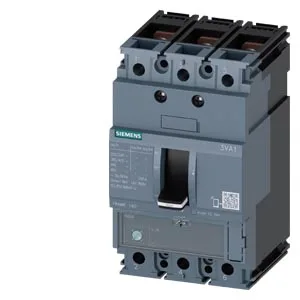
160 A, 3-pole MCCB for line protection — what the ratings mean on the panel floor
The Siemens 3VA1116-5EE32-0HH0 is a SENTRON molded case circuit breaker (MCCB) designed for line protection — meaning it sits upstream of branch feeders, not downstream at a motor or load. Rated 160 A continuous at 40 °C, it holds that full rating through 50 °C (–), then derates gently to 150 A at 70 °C. That thermal curve is what matters for a panel builder: you can size the breaker for a 160 A bus without oversizing the enclosure for derating, as long as ambient stays under 50 °C. Above that, you lose roughly 1 A per 5 °C rise. Interrupting capacity is the headline number that decides whether this breaker clears a fault or welds shut. At 240 V it handles 187 kA; at 415 V, 121 kA; at 440 V, 75.6 kA; at 500 V and 690 V, 17 kA (–). For a 480 V panel in North America, the relevant figure is the 415 V rating — 121 kA — which covers most utility transformer secondary faults. The 800 V rated insulation voltage means the breaker's internal clearances are designed for 600 V class systems with margin. Three-pole construction with a shunt trip (STL) auxiliary release and two auxiliary switches plus one trip alarm switch. The trip indicator gives a local visual flag — useful when the breaker is in a remote MCC bucket and you need to confirm it tripped before resetting. No undervoltage release, no ground-fault monitoring, no communication function — this is a straightforward line-protection breaker, not a power-monitoring device.
Panel fit — DIN-rail footprint and wiring constraints
The 3VA1116-5EE32-0HH0 measures 70 mm deep, 76.2 mm wide, and 130 mm tall. That 76.2 mm width — exactly 3 inches — is the standard 3-pole MCCB footprint for the SENTRON 3VA platform. It mounts on a DIN rail or bolts into an MCC bucket; the depth is shallow enough to clear a 120 mm deep enclosure door without interference. Power loss is 38 W maximum, so factor that into enclosure thermal calculations if the panel is sealed and unventilated.
