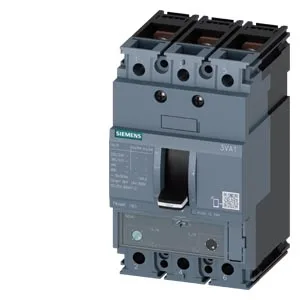
What the 160 A rating means for your panel
That thermal curve means the breaker handles full-rated load in most ventilated enclosures without forced cooling. The 3-pole design (cites:) is configured for line protection (cites:), so it's the primary feeder breaker for a distribution panel, not a motor-circuit protector. Breaking capacity is the headline number for fault coordination: 187 kA at 240 V (cites:), 121 kA at 415 V (cites:), 75.6 kA at 440 V (cites:), and 17 kA at both 500 V and 690 V (cites:,). At the common 480 V panel voltage, the 75.6 kA rating gives substantial headroom above typical 65 kA or 100 kA SCCR requirements — useful when the utility transformer is close and fault current runs high.
Built-in undervoltage release and auxiliary switching
That's standard for applications where a brownout must disconnect loads to prevent motor contactor chatter or uncontrolled restart. The UVR is factory-fitted, not a field-add kit, so the BOM line is clean. Two auxiliary switches (HQ type) are also included (cites:), giving status feedback for the open/closed position — enough for a remote indication lamp or a PLC digital input without an add-on module.
Panel fit and thermal management
Dimensions are 70 mm deep, 76.2 mm wide, and 130 mm tall (cites:,) — a standard 3-pole MCCB footprint that drops into most SENTRON distribution panels without re-drilling the mounting plate. Max power loss is 40.5 W (cites:); at full 160 A load that heat has to be vented. In a sealed enclosure with no fan, check the internal temperature rise against the derating curve above 50 °C.