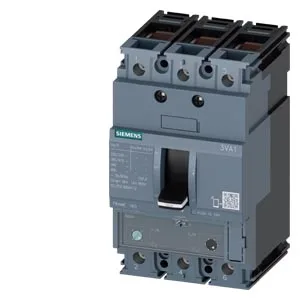
What this MCCB carries and where it fits
The Siemens SENTRON 3VA1116-5EF36-0DH0 is a 3-pole molded case circuit breaker rated for 160 A continuous current (Iu) with a TM240 thermal-magnetic overcurrent release. It is a line-protection version — no voltage trigger, no communication function, no phase failure detection — built for straightforward feeder or main breaker duty in distribution panels. Its interrupting capacity hits 187 kA at 240 V, 121 kA at 415 V, 75.6 kA at 440 V, and 17 kA at 690 V. That 187 kA figure at 240 V means it can clear a bolted fault on a high-capacity transformer secondary without the arc re-striking — a spec that matters when the panel feeds a large motor control center or a critical process line where a downstream short could otherwise cascade upstream. The breaker carries an undervoltage release (UVR) as the auxiliary release, plus 2 auxiliary switches and 1 trip alarm switch (HQ version). The integrated auxiliary trip is order code 3VA9608-0BB25. Latching endurance is rated at 15,000 operations — a solid figure for a main breaker that sees infrequent switching but needs to be reliable when it does operate.
Thermal derating and ambient conditions
The 160 A rating holds flat from 40 °C through 50 °C ambient. Above that it derates: 153.6 A at 55 °C, 150.4 A at 60 °C, 147.2 A at 65 °C, and 144 A at 70 °C. If the panel is in a hot mezzanine or near a furnace line, plan for the 144 A ceiling at 70 °C rather than the nameplate 160 A. Operating range spans -25 °C to 70 °C; storage range is -40 °C to 80 °C. Dimensions are 130 mm height, 76.2 mm width, 70 mm depth — a 3-pole MCCB that fits standard Siemens SENTRON mounting footprints. The 76.2 mm width (3 inches) is the same as the 3VA1112 and 3VA1110 siblings, so a panel drilled for those will take this 160 A version without reworking the gland plate or bus bar layout. IP40 on the front means it's protected against tools and wires >1 mm but not against water — keep it inside a rated enclosure.
What it does not include
No ground fault monitoring, no communication module, no phase failure detection, no voltage trigger. The overcurrent release is TM240 — thermal-magnetic, not electronic. If the application requires ground fault protection or Modbus communication, this is not the variant; look at the 3VA2 series with electronic releases.
