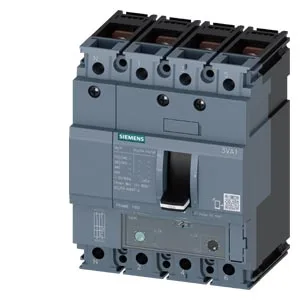
Its headline figure is the interrupting capacity: 187 kA at 240 V, 121 kA at 415 V, 75.6 kA at 440 V, and 17 kA at 690 V. That 187 kA at 240 V means this breaker can safely clear a fault current up to 187 000 A without welding contacts or rupturing the case — critical for high-fault locations like transformer secondaries or large motor control centers where available fault current can exceed 100 kA. The 121 kA at 415 V covers most European industrial grids; the 17 kA at 690 V is enough for most 690 V drives and mining gear.
Thermal-magnetic release and continuous current ratings
The TM240 overcurrent release is a thermal-magnetic trip unit — thermal element handles overloads (inverse-time curve), magnetic element handles short-circuits (instantaneous). Above 50 °C you need to derate: 153.6 A at 55 °C, 150.4 A at 60 °C, 147.2 A at 65 °C, and 144 A at 70 °C. That derating curve is typical for thermal-magnetic breakers — the bimetallic strip heats up faster in a hot enclosure. The 4-pole configuration handles three-phase plus neutral (or four-phase) circuits; the neutral pole may be unprotected (no N-conductor protection fitted) — verify your system grounding before wiring.
Dimensions: 70 mm depth, 101.6 mm width, 130 mm height. That 101.6 mm width is a standard 4-pole MCCB footprint — it occupies four 25.4 mm (1-inch) module positions on a DIN rail or panel-mount base. The 15 000 mechanical endurance cycles (latching) are typical for a 160 A frame — expect longer life in lightly cycled distribution duty, shorter in frequent switching applications.