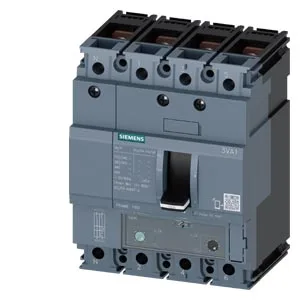
That 160 A holds flat from 40 °C to 50 °C, then derates to 144 A at 70 °C — so if this lands in a hot panel or outdoor enclosure, the usable ampacity drops 10 % at the high end. The interrupting ratings are the headline: 187 kA at 240 V, 121 kA at 415 V, 75.6 kA at 440 V, and 17 kA at 690 V. Those numbers mean it can clear a fault upstream of a 2 MVA transformer at 240 V without the arc re-striking, which is the kind of SCCR headroom a site electrical engineer needs for a service-entrance or main-feeder position.
At 101.6 mm wide, 130 mm tall, and 70 mm deep, this MCCB fits a standard 4-pole mounting footprint. The TM240 release is fixed-thermal, not electronic, so there's no phase-failure detection or communication function on this variant.
What this MCCB is used for
As a line-protection MCCB, it sits between the transformer secondary and the distribution bus, or as a main breaker in a panel feeding motor control centers and lighting sub-panels. The 4-pole configuration handles three-phase plus neutral, common in North American 120/208 V and 277/480 V systems as well as international 400/690 V networks. The undervoltage release lets a safety circuit or emergency-stop chain trip the breaker open when control voltage drops — a standard requirement in machine safety circuits per IEC 60204-1.