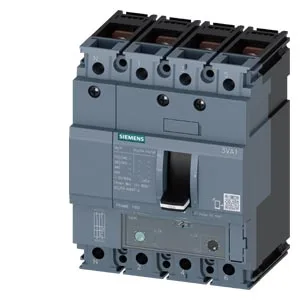
It is a 4-pole unit, rated 160 A continuous at 40 °C ambient, and carries a breaking capacity of 187 kA at 240 V AC — that is the maximum fault current it can safely interrupt without welding or rupturing.
The 187 kA at 240 V is the high-end short-circuit rating; at 415 V it is still 121 kA, and at 690 V it drops to 17 kA. That means this breaker can be used in high-fault locations (close to a transformer or generator bus) as long as the system voltage is matched. The thermal derating curve is flat from 40 °C to 50 °C — still 160 A — then drops to 150 A at 70 °C.
Integrated auxiliary and undervoltage release
This variant ships with two auxiliary switches (HQ type) and an undervoltage release (UVR). The auxiliary switches give you status feedback (open/closed/tripped) for a PLC or remote indication, without needing an add-on module.