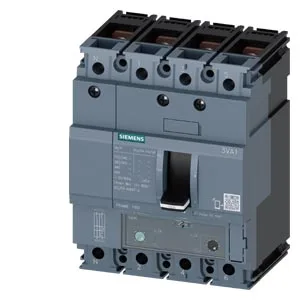
What this MCCB does and what the ratings mean
The Siemens 3VA1116-5EF42-0DA0 is a SENTRON molded case circuit breaker (MCCB) built for line protection — meaning it sits at the feeder or main breaker position in a panel, protecting downstream cables and buswork from overloads and short circuits. It's a 4-pole unit rated 160 A continuous at 40 °C. That 160 A holds steady through 50 °C, then derates to 150 A at 70 °C. The interrupting ratings tell you where it can safely clear a fault: 187 kA at 240 V, 121 kA at 415 V, 75.6 kA at 440 V, and 17 kA at 500 V and 690 V. On a 480 V panel (common in North America), the 75.6 kA at 440 V gives you a solid floor — plenty of headroom for most industrial services. The overcurrent release is the TM240 — a thermal-magnetic trip unit, fixed at 160 A, with a thermal curve for overloads and a magnetic pickup for short circuits. No trip indicator, no voltage trigger, no communication function. What it does carry is an undervoltage release (UVR), which will trip the breaker if control voltage drops below a set threshold — useful for emergency-stop circuits or undervoltage protection on motor feeders. Insulation voltage is rated 800 V, and maximum power loss at rated load is 40.5 W.
Where it fits and how it mounts
This MCCB is a panel-mount device — it bolts into a switchboard or distribution panel via its fixed (non-plug-in) base. Dimensions are 130 mm tall, 101.6 mm wide, and 70 mm deep. That 70 mm depth matters for shallow enclosures: it's a compact footprint for a 160 A 4-pole breaker. Wiring access is from the front and bottom; no special DIN-rail adapter needed. Operating temperature range is -25 °C to 70 °C, storage from -40 °C to 80 °C.
