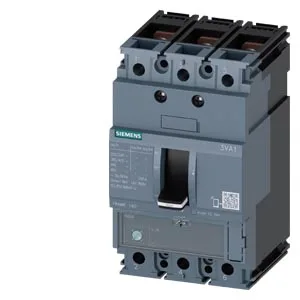
Its job is to isolate the panel and clear faults before they cascade downstream. At 55 °C it carries 158 A, at 60 °C it carries 155 A, at 65 °C it carries 153 A, and at 70 °C it carries 150 A — so in a warm enclosure you lose about 2 A per 5 °C rise above 50 °C. That thermal curve is what you use to size the breaker for actual panel conditions, not the nameplate. Interrupting capacity is the headline number for a main breaker: 220 kA at 240 V, 154 kA at 415 V, 75.6 kA at 440 V, and 17 kA at 500 V and 690 V.
Overcurrent release and trip characteristics
The overcurrent release is designated TM220 — a thermal-magnetic type. TM220 is a standard fixed-trip release; there is no electronic adjustment or communication module on this variant. No undervoltage release, no voltage trip, no ground-fault monitoring, and no communication function are fitted. This is a plain-vanilla thermal-magnetic MCCB for straightforward line protection where remote monitoring or shunt-trip functions are not required.
That 3-inch width (76.2 mm) is standard for a 3-pole SENTRON 3VA frame — it occupies three 25 mm module spaces on a DIN rail or mounting plate. Depth of 70 mm (2.76 in) leaves clearance for rear busbar connections in a typical distribution panel. Front face carries IP40 protection — suitable for general indoor panel installation where no water jets or dust ingress are expected. The enclosure itself is not sealed for washdown.