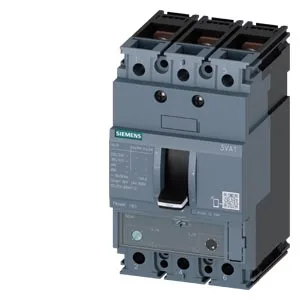
That TM240 designation means the thermal pickup is fixed at 160 A (the frame rating), while the magnetic short-circuit trip is set at 240 A — so it protects a 160 A feeder against overloads and low-level faults, but lets short-duration inrush from motor loads or transformers pass without nuisance tripping. The 160 A rating holds steady from 40 °C up to 50 °C ambient; above that it derates in steps to 144 A at 70 °C, which matters if this breaker lands in a hot enclosure near other heat sources. Breaking capacity is where this breaker earns its keep in high-fault panels. At 240 V it interrupts 220 kA; at 415 V, 154 kA; at 440 V, 75.6 kA; and at 690 V, 17 kA. Those numbers cover everything from a 240 V lighting panel to a 690 V industrial motor center.
Built-In Undervoltage Release and Auxiliary Contacts
The UVR is designed into the breaker body, not a field-add-on, so the wiring plan needs to account for the release coil supply. The breaker mounts with a 76.2 mm width and 130 mm height — standard SENTRON 3VA footprint for the 160 A frame. Depth is 70 mm from the mounting surface to the front of the handle.
Does It Drop Into a Panel Built for the 3VA1112-5EF32-0CA0?
If you're swapping from the 3VA1112-5EF32-0CA0 (a 125 A frame with an ETU electronic trip), the 3VA1116-6EF32-0DC0 shares the same 76.2 mm width and 130 mm height — same mounting hole pattern, same bus-bar spacing for a 3-pole SENTRON. The depth is identical at 70 mm. No rewiring of the line or load lugs is needed; the physical footprint is a drop-in. What changes is the trip curve: the TM240 is thermal-magnetic, not electronic, so coordination studies and arc-flash labels need updating. The auxiliary contact count matches (2 HQ on both), and the UVR is present on both variants.
Line Protection — No Communication, No Ground Fault
It's a basic thermal-magnetic MCCB for feeder protection where you don't need remote trip indication or leakage monitoring. The integrated auxiliary trip (3VA9608-0BB25) is the only accessory release beyond the UVR; there's no shunt trip or voltage trigger on this variant. If your spec calls for ground-fault or Modbus, you'd step up to the 3VA1 ETU series.